

There comes a moment where you discuss a character which you pictured in your mind for years, and which an AI merely generates. Not so much, but close enough that you involuntarily sink the jaw makeplush ai anime generator.
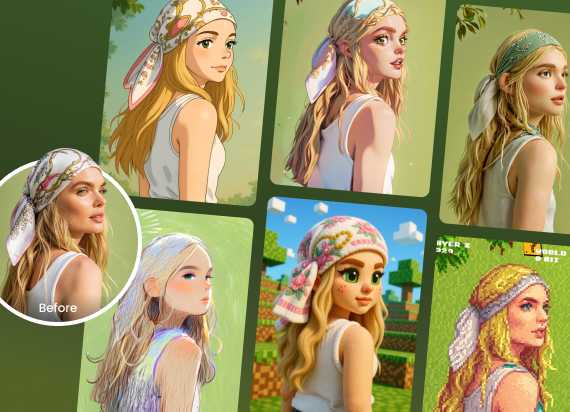
That's what AI anime generators do, and it is genuinely impressive.
To be real. Most people can't draw to save their lives. We tried during the pandemic, filled notebooks with potato-shaped heads and shelved that idea. AI anime tools are the revenge arc which nobody thought was possible.
But how do these tools actually work?
Most AI anime generators are trained on diffusion-based models — that is to say, the AI is trained by analyzing thousands of existing anime images until it understands what makes a face feel distinctly anime, or what makes this kind of light Makoto Shinkai. It is a staggering level of pattern recognition.
Some are even more — such as NovelAI or Stable Diffusion specifically tuned for anime. You can enter timely engineering: You can enter the art style, color palette, or even the expression on the face. Pastel tones, sad eyes, cherry blossoms drifting down — and away it goes.
Then there are tools, like Adobe Firefly or Midjourney, that lean more general. They don't focus purely on anime, however, yet they can provide gorgeous anime-style outputs when pushed correctly.
Prompting is everything. Seriously.
An "anime girl" can't just be typed into a box. It is simply equivalent to giving a chef a single item and asking them to create a tasting menu. The recipients of most of the outputs are now addressing prompts as a fine art — detailed lighting descriptions, indicating specific studios, detailing the thickness of the lines.
Full body, soft light, Studio Trigger, white school uniform, golden hour background, very detailed — now that's a prompt with weight.
There are a small, yet active community pockets swapping techniques with the same energy as holo rares are shared among card collectors. They're obsessive, and honestly, to watch them at work is a motivational affair.
What is this what people are using it for?
More people than you'd expect. Developers are designing character concept art without commissioning an artist for each one. Webtoon artists are experimenting with AI-based panel layouts and making it part of their workflow. Fans are generating images as visual references to the characters in their fanfiction — which is a phenomenon, and they do not take it lightly.
One of the designers with whom I exchanged introductions had been working on the same fantasy novel in six years. She had never found herself at a stand to visualize her protagonist clearly. One afternoon, an AI anime generator and she finally had a glimpse of her character. It cleared two years' worth of creative block, she said.
That's not nothing. That's genuinely powerful.
But it's not all cherry blossoms and sparkly eyes.
The ethics are murky. The vast majority of such models have been trained on images scraped from sites like Danbooru or Pixiv — a place which artists posted their work long before knowing that one of their creations will eventually drive a machine.
Plenty of artists are upset. Fair or not, depending on your view. Others have started to use AI as a creative springboard when they handle the final details themselves. The range of answers is broad.
Then there's the quality ceiling issue. Hands. Toes. Intricate backgrounds. The AI still fumbles these sometimes — in a subtle manner or completely out of its hinges. The 6 finger hand that was meant to be beautiful is very much not.
Where does it all go from here?
Rapidly. That's the real answer. Character consistency — maintaining the same character across multiple scenes — has gotten significantly better this year. Tools like Fooocus and Kohya with LoRA training help to refine on a specific character style and maintain it across scenes.
Video is the next frontier. AI anime video clips are already out there. They're rough, no doubt. A year ago they were barely moving slideshows. Now? Sometimes you'd swear a small studio made them.